


Labradorite
Labradorite is a feldspar mineral and is an intermediate to calcic member of the plagioclase series. The streak is white, like most silicates. As with all plagioclase members, the crystal system is triclinic, and three directions of cleavage are present, two of which are nearly at right angles and are more obvious, being of good to perfect quality. It occurs as clear, white to gray, blocky to lath shaped grains in common mafic igneous rocks such as basalt and gabbro, as well as in anorthosites.
Its formula is: ((Ca, Na)(Al, Si)4O8)
The geological type area for labradorite is Paul’s Island near the town of Nain in Labrador, Canada. It has also been reported in Norway, Finland and various other locations worldwide.
Labradorite can display an iridescent optical effect (or schiller) known as labradorescence.
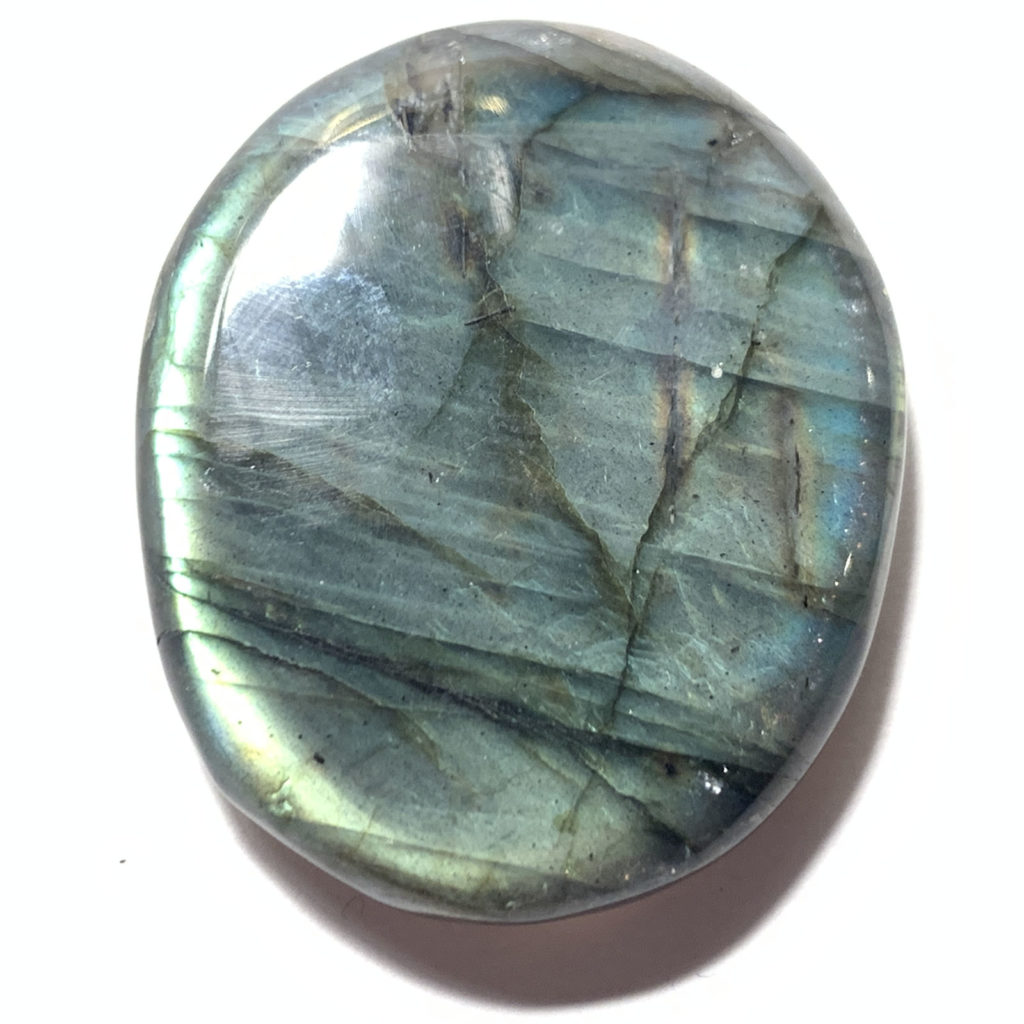
Iridescent, labradorescence and spectrolite
Iridescence (also known as goniochromism) is the phenomenon of certain surfaces that appear to gradually change color as the angle of view or the angle of illumination changes. Examples of iridescence include soap bubbles, feathers, butterfly wings and seashells, as well as certain minerals. It is often created by structural coloration (microstructures that interfere with light).
Some gemstone varieties of labradorite exhibiting a high degree of labradorescence are called spectrolite.
1 in stock

Lucky
$150.001 in stock
