


Amethyst
Amethyst is a violet variety of quartz. The name comes from the Koine Greek amethystos (from “not”) and methysko (/ methyo, “intoxicate”), a reference to the belief that the stone protected its owner from drunkenness. The ancient Greeks wore amethyst and carved drinking vessels from it in the belief that it would prevent intoxication.
Amethyst is a semiprecious stone often used in jewelry and is the traditional birthstone for February.
Its formula is: SiO2
The hardness of the mineral is the same as quartz, thus making it suitable for use in jewelry.
Tibetans consider amethyst sacred to the Buddha and make prayer beads from it.
Up until the 18th century, amethyst was included in the cardinal, or most valuable, gemstones (along with diamond, sapphire, ruby, and emerald). However, since the discovery of extensive deposits in locations such as Brazil, it has lost most of its value.
Collectors look for depth of color, possibly with red flashes if cut conventionally. As amethyst is readily available in large structures the value of the gem is not primarily defined by carat weight; this is different from most gemstones where the carat weight exponentially increases the value of the stone. The biggest factor in the value of amethyst is the color displayed.
The highest grade amethyst (called “Deep Russian”) is exceptionally rare and therefore, when one is found, its value is dependent on the demand of collectors. It is, however, still orders of magnitude lower than the highest grade sapphires or rubies.
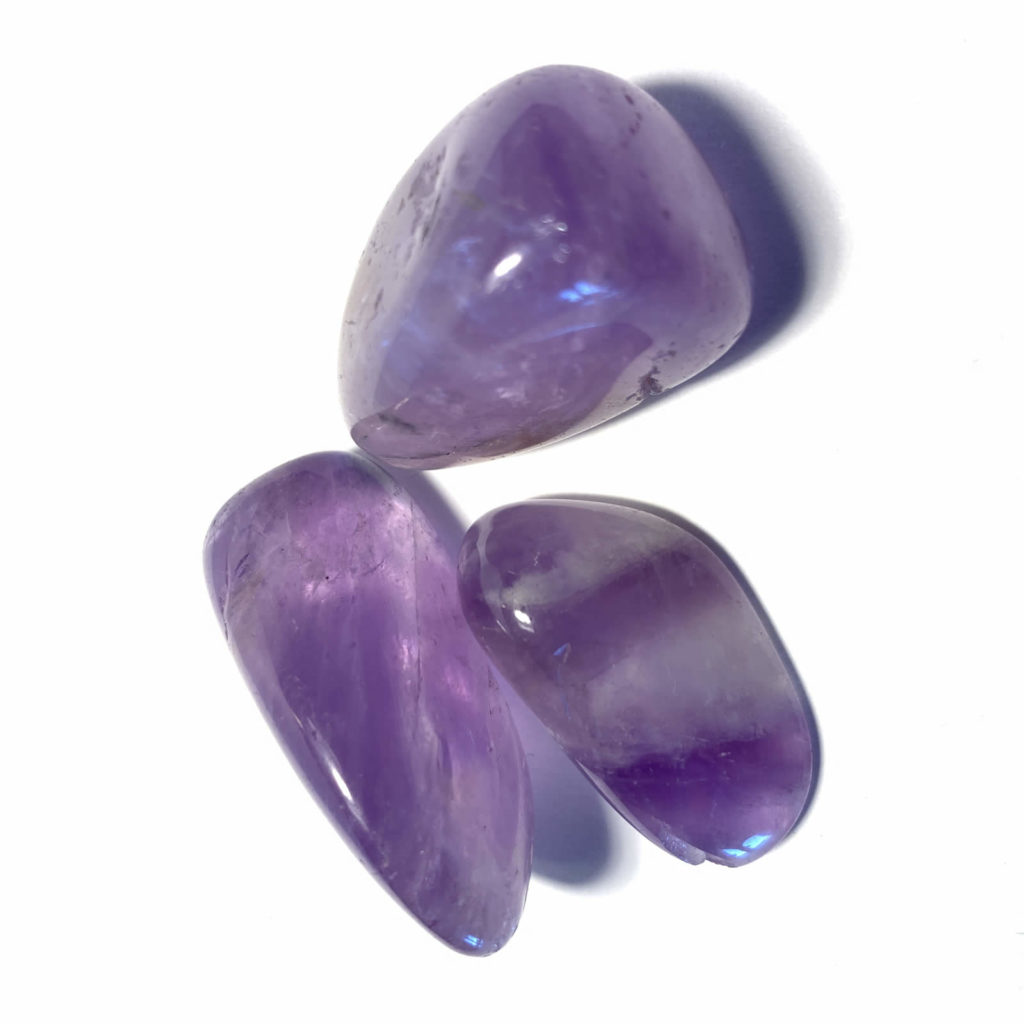
Found in as many places as Brazil, Bolivia, Mexico, Africa, Canada, Russia, USA and Europe, this stone has a rich history of astonishing civilizations with its stunning, saturated beauty. While the Neolithic people in Europe it as a mere decorative emblem around 25,000 B.C., Ancient Greeks and Romans used amethyst in several ways from beads in jewelry to amulets. These ancient civilizations placed a high value in this stone. Their belief was that the amethyst crystal meaning was synonymous with luxury. As such, it was highlighted as part of their crowns, scepters and rings.
1 in stock

Heart 1
$150.001 in stock
