


Fluorite
Fluorite (also called fluorspar) is the mineral form of calcium fluoride. It belongs to the halide minerals. It crystallizes in isometric cubic habit, although octahedral and more complex isometric forms are not uncommon.
Its formula is: CaF2
Fluorite is a colorful mineral, both in visible and ultraviolet light, and the stone has ornamental and lapidary uses. Industrially, fluorite is used as a flux for smelting, and in the production of certain glasses and enamels. The purest grades of fluorite are a source of fluoride for hydrofluoric acid manufacture, which is the intermediate source of most fluorine-containing fine chemicals. Optically clear transparent fluorite lenses have low dispersion, so lenses made from it exhibit less chromatic aberration, making them valuable in microscopes and telescopes. Fluorite optics are also usable in the far-ultraviolet and mid-infrared ranges, where conventional glasses are too absorbent for use.
The word fluorite is derived from the Latin verb fluere, meaning to flow. In 1852, fluorite gave its name to the phenomenon of fluorescence, which is prominent in fluorites from certain locations, due to certain impurities in the crystal. Fluorite also gave the name to its constitutive element fluorine. Presently, the word “fluorspar” is most commonly used for fluorite as the industrial and chemical commodity, while “fluorite” is used mineralogically and in most other senses.
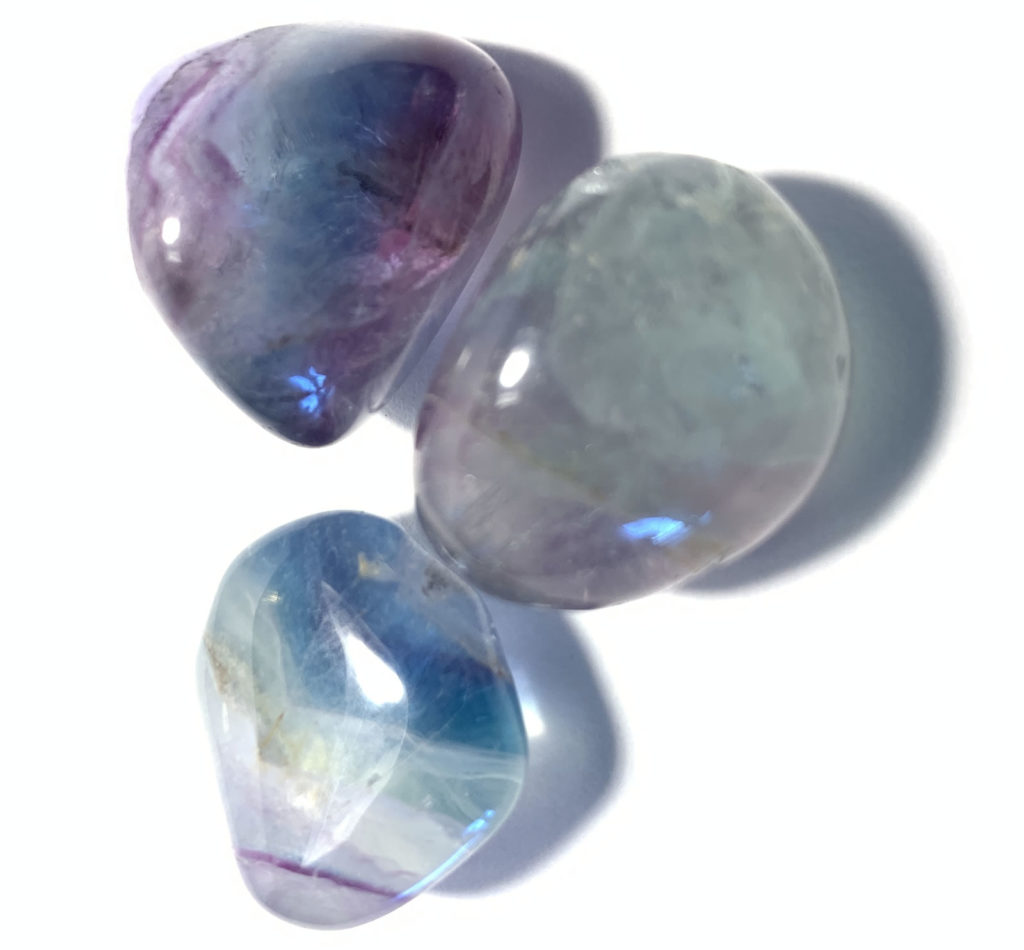
Fluorite can have Fluorescence
Fluorite is one of the minerals that can fluoresce. Using UV light you can bring out some very interesting florescence colors of white, purple, red, yellow, green, and blue being the most common color exhibited. This is one of the reasons many like to obtain a nice specimen of fluorite… Did you know that a man named George Gabriel Stokes discovered the phenomenon of fluorescence in 1852 through a paper he wrote on the change of wavelength of light? In his paper he noted that fluorspar and uranium glass while viewed under ultra-violet radiation would emit light that can could become visible. He coined the term florescence from the mineral fluorspar.
1 in stock

The Beautiful One
$150.001 in stock
